
Old Watches for Women and the Glitz of Old-Fashioned Casino Nights
Vintage watches for women are one of the few items that perfectly combine artistry, femininity, and cultural ambition. From the slim jewelled dress watches of the 1950s to the bold architectural dials of the 1970s, these watches have always been more than just tools. They spoke about style, occasions, and the quiet confidence that defined an era. That legacy endures today, and collectors around the world continue to search for the watches that made history on the wrists of remarkable women.
That confidence was most apparent on the floor of a classic casino. The women who frequented the baccarat rooms and roulette salons of Monte Carlo, Las Vegas, and Macau chose their watches with the same deliberateness — as accessories that communicated presence, taste, and readiness for whatever the evening might bring — just as players at Spinsahara Casino bring their sharpest judgment and a genuine sense of occasion to every game. The watch was never merely decorative. It said something.
How Vintage Women's Watches Have Always Been Linked to Casino Style
In the mid-20th century, the great gambling establishments were as much performance venues as places to play and to see shows. The Salon Privé in Monte Carlo, the grand rooms of the Sands in Las Vegas, and the gold-lined interiors of Macau's earliest venues all demanded a particular standard of dress. When women entered these spaces, they understood that every aspect of their appearance carried social meaning. Even the wristwatch — whether glimpsed at the cuff of a glove or against a silk sleeve — was never an accident.
The watch mattered in this world because it was simultaneously functional and deeply personal. What a woman chose to wear on her wrist could signal her background, her sophistication, and her independence. Vintage womens watches from this period were often custom-ordered, presented as gifts by admirers, or selected with the guidance of jewellers who understood that the right piece made everything else come into focus.
The wristwatch became, in the casino's golden age, the one accessory a woman wore that spoke entirely for itself — not borrowed glamour, but a quiet, precise statement of who she was.
The Casino as a Live Theatre and the Watch as Symbol
The particular pressure of casino style had a direct influence on the watchmaking industry. Manufactures began producing pieces intended specifically for evening wear: smaller cases, highly polished dials set with diamonds or enamel, and bracelets that blurred the boundary between watch and jewel. These were not everyday tools. They were objects made for a specific context — low lighting, formal attire, and high stakes. Womens vintage watches from this period remain among the most coveted jewellery-adjacent pieces in the market today.
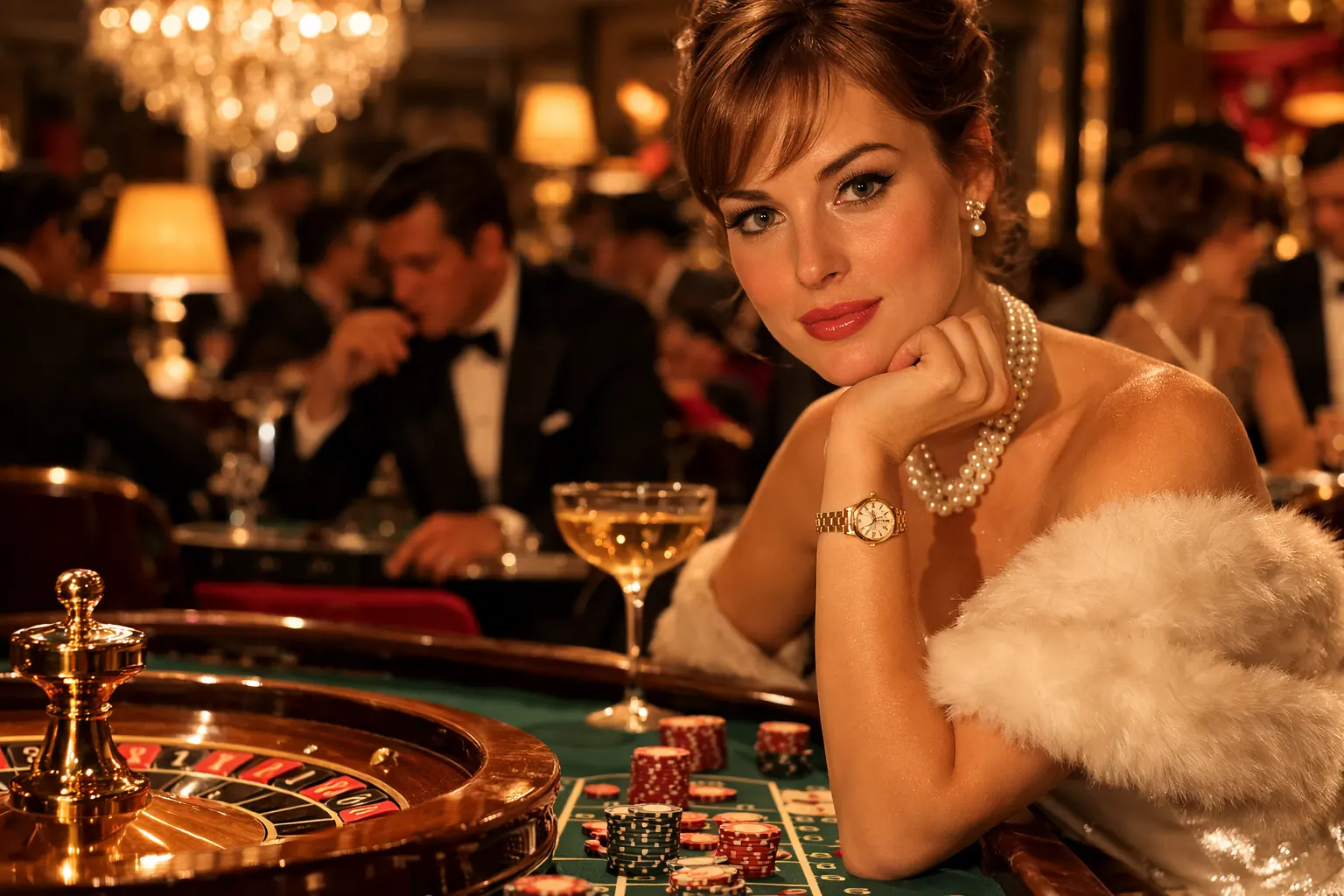
How the Casino Circuit Changed Demand for High-End Watches
In the decades following World War II, the international gambling circuit stretched from the Côte d'Azur to Cuba (before 1959), then to Atlantic City and Macau. It was where the world's wealthiest and most stylish visitors converged. Watchmakers took notice. Houses such as Van Cleef & Arpels, Cartier, Patek Philippe, and Jaeger-LeCoultre developed collections aimed directly at this clientele. The demand that emerged from the casino circuit shaped the design ambitions of an entire generation of manufacturers.
The appetite for vintage style watches for women was driven in large part by the social dynamics of the gambling world:
- Jewellery-grade finishing was placed front and centre, given the visibility of small, well-lit social spaces
- Strict dress codes at casinos created a clear need for watches made specifically for evening occasions
- Internationally mobile, wealthy guests broadened global awareness of European watch brands
- Casino gifts and tokens of affection — often fine watches — became a significant part of the social fabric of the time
- Press coverage and film depictions of casino life made the objects worn there aspirational worldwide
- The rise of women as active gamblers in the 1960s created a new and assertive customer base
- Estate auction records from socialites of the casino era consistently feature watches from this period
How Vintage Style Watches for Women Became Fashion Icons in the 1960s and 1970s
As women's fashion shifted in the 1960s, watchmakers responded with equal energy. The structured elegance of the previous decade gave way to something more playful and geometric. Dials became expressive. Cases took on oval, tonneau, or asymmetrical forms. The watch was no longer merely an accessory — it was a design statement and a cultural artefact of a decade redefining what luxury could look like.
By the 1970s, the transformation was complete. Many collectors now consider this the most experimentally rich decade in women's watch design. Wide, textured bracelets, enamel dials in vivid colour, and modular cases constructed from interlocking geometric shapes appeared under casino lighting to striking effect. These pieces were confident, artistic, and unapologetically bold — made for exactly that world.
Watch Styles of Casino Culture Defined by Decade
| Decade | Style of Design | Key Features | Iconic Pieces |
|---|---|---|---|
| 1950s | Fine elegance | Small cases, diamond crowns, luminescent hands | Cartier Tank, Patek Ref. 3249 |
| 1960s | Playful modernity | Oval and tonneau shapes, textured dials | Omega De Ville, Jaeger-LeCoultre Rendez-Vous |
| 1970s | Bold architecture | Wide bands, enamel, sculpted cases | Audemars Piguet Lady Royal Oak, Piaget Polo |
| 1980s | Confident glamour | Two-tone cases, larger dials, quartz movements | Rolex Datejust Lady, Cartier Must de Cartier |
The Role Film and Celebrities Played in Cementing the Look
Cinema was a powerful force in merging the imagery of gambling and fine watches. From the first James Bond film in 1962 onward, watches became central to the language of glamour and intrigue. The women in these films were dressed with the same intentionality as the men, and the pieces they wore on-screen became objects of desire. Beyond the Bond franchise, European art films and American studio productions consistently featured recognisable watches in gambling scenes, helping to cement certain references as cultural icons.
What Makes Vintage Womens Watches Distinctive in Their Design
What distinguishes vintage watches for women from their modern counterparts is more than age alone. It derives from a set of design principles that are difficult to replicate at scale in contemporary production: attention to proportion, material integrity, and handcraft. Many collectors encountering these pieces for the first time remark that they feel entirely different from anything made in the last thirty years. The finish is of another order, and the assembly reflects a level of care that speaks immediately.
The case is usually where the distinction begins. Vintage cases were machined with precision that gave their lugs a crisp silhouette and a weight that felt purposeful without being heavy. Finishing — the alternation between brushed and polished surfaces — involved hours of hand work that most contemporary manufacturers could not replicate at that price point.
Key Design Elements and Why Collectors Seek Them
| Design Element | Peak Use Period | Collector Value | Level of Rarity |
|---|---|---|---|
| Diamond-set bezels | 1950s–1970s | High — implies quality original stones | Great |
| Enamel dials (guilloché) | 1960s–1970s | Very High | Very labor-intensive, fragile |
| Integrated designed bracelets | 1970s | High — seamless case-to-band look | High |
| Hand-finished movements | 1950s–1960s | Thin profile, high mechanical purity | Medium–High |
| Original hand-signed buckles | All periods | Proof of origin and completeness | High |
The Materials That Make Vintage Pieces Singular
The materials used in 1960s and 1970s watchmaking each carry their own character. Eighteen-karat yellow gold was the predominant case metal for dress watches intended for casino or evening wear; its warmth made dials read beautifully under artificial light. White gold and platinum appeared in jewellery-grade pieces, particularly those set with diamonds or sapphires. Dial materials from the era — silver guilloché, cloisonné enamel, and champagne-toned radium lume — are increasingly difficult to source, and they give older watches their uniquely layered visual depth.
When you hold a 1960s Jaeger-LeCoultre dress watch and feel the snap of the case back and the depth of that guilloché dial, you understand immediately why collectors spend years searching for a single reference. These objects were made to last centuries, not product cycles.
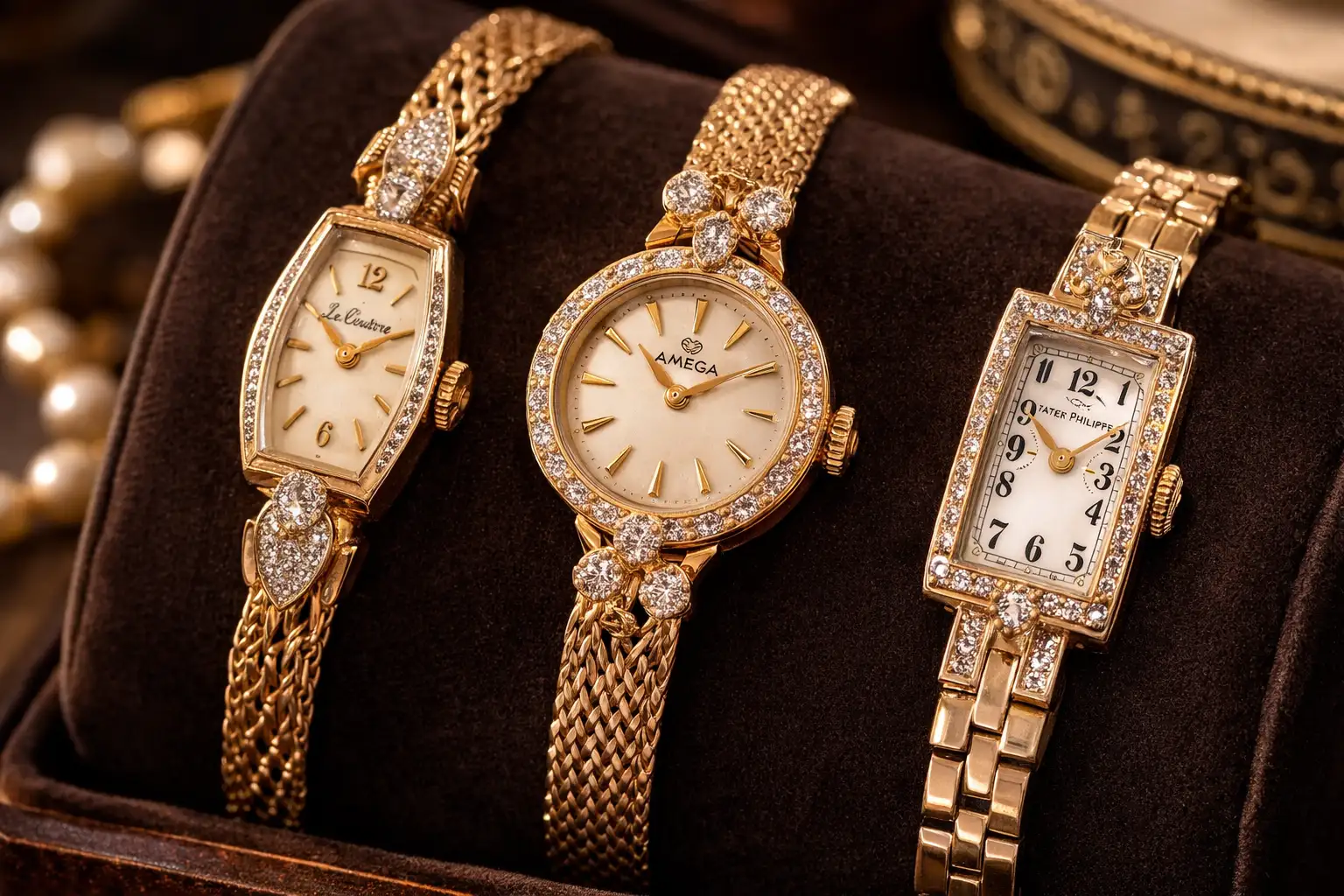
Vintage Designer Watches Women Still Seek Today, Inspired by Old Casino Glamour
The aesthetic influence of casino-era watchmaking on the industry is unmistakable. Every few years, the major houses revisit the slim case shapes, jewelled bezels, and bracelet-integrated designs of the mid-century period. This is not nostalgia for its own sake — the design logic of those years remains valid. What worked on a woman's wrist at the baccarat table in 1968 still works today.
Smaller ateliers and independent makers have responded to this tradition with particular attentiveness. Drawing on casino-era proportions and materials for inspiration, they produce modern pieces that sit comfortably alongside original vintage examples. For collectors who cannot access or afford the finest originals, these neo-vintage references represent a genuine alternative. They follow the same design logic.
What Makes a Watch Feel Genuinely Vintage?
Several qualities together mark the difference between a watch that merely looks old and one that truly captures the spirit of an era. Proportion is the most critical. Generations of makers who understood how a watch should sit on a woman's wrist refined the relationship between case size, dial layout, and bracelet width. Restraint matters equally. The best vintage-inspired designs, like their predecessors, resist overcrowding — they do not add complexity where simplicity serves better. Light also plays its role. A well-finished gold case in the evening has a quality that no plated base metal can match. All designs drawing on this history must ultimately be judged against these standards.
How Modern Collectors Wear Vintage Style Watches for Women on Evenings Out
Collectors of vintage style watches for women approach them in much the same spirit as those who first wore them: as the centrepiece of an evening ensemble. Worn with minimal other jewellery, a fine antique piece commands attention without excess. Paired with silk or satin, it draws a visible thread between different periods. The watch becomes a personal artefact — something with a provenance, a story, and a context that a new purchase cannot immediately provide. That may be the deepest appeal of the casino-era aesthetic: it carries evidence of a life fully considered.
Buying Vintage Designer Watches Women Still Covet Today
The market for vintage womens watches has matured considerably over the past two decades. What was once a niche pursuit followed by a small number of specialists has grown into a global market underpinned by major auction houses, dedicated dealers, online platforms, and active collector communities. Prices at the very top of the market — particularly for signed jewellery pieces by Cartier, Patek Philippe, and Van Cleef & Arpels — have risen substantially, driven by increasing demand and finite supply.
The most consequential shift in recent years has been the emergence of women as active buyers and enthusiasts in their own right, rather than recipients of gifts. This has professionalised the conversation around vintage watches for women, with greater emphasis on authenticity, condition, and fair valuation. Auction specialists report consistent demand for mid-century women's dress watches, and well-documented examples in original condition achieve prices that would have seemed implausible a decade ago.
Getting Started: Considerations for New Collectors
The market offers both accessible entry points and exceptional rarities for those beginning a collection. Smaller Swiss houses — Longines, Movado, Omega, Tissot — produced dress watches throughout the 1960s and 1970s that can still be found in fine condition at prices proportionate to their quality. Estate sales, specialist auctions, and trusted online sellers represent the most reliable acquisition channels, though careful verification of service history, originality of components, and dial condition is essential before any purchase.
Important things to know before buying vintage designer watches for women:
- Confirm dial originality — refinished dials significantly reduce both value and historical integrity
- Request service records where available; a recently serviced movement adds confidence and value
- Examine case metal hallmarks to verify gold content and country of origin
- Check bracelet completeness — sourcing missing links can be difficult and costly
- Cross-reference reference numbers against reliable published sources before agreeing to a price
- When buying online, consider the seller's reputation and returns policy carefully
- Factor in the cost of specialist insurance for any valuable acquisition
Where to Build Knowledge and a Collection
Expertise develops over time, but the resources available now make the learning curve less steep than it once was. Auction catalogues from Christie's, Sotheby's, and Phillips serve as authoritative guides to identification and valuation. Collector forums and watch-specific publications bring enthusiasts together to share knowledge openly. Curated platforms carefully select pieces from the most significant periods of women's watch history and contextualise them in ways that help newer collectors understand what they are looking at. Handling pieces directly — at auctions, through dealers, or at collecting events — remains the surest way to develop an eye for quality and authenticity.
At its core, the story of vintage watches for women is about how craft and intention meet. One of the most vivid expressions of that union was the casino floor, where the desire for objects that were at once beautiful and precise, personal and performative, was most acute. The watches produced for that world remain among the most compelling in the history of the industry. For collectors willing to be patient, they offer something irreplaceable: a direct, physical connection to a world of considered elegance that speaks clearly across the decades.